01 / Albums & credits
Keith Olsen Discography and Selected Album Credits
A listening map of selected recordings, with the distinctions that make production credits useful.
PreparedAlbums, artists and the craft of recording. Explore a production career that connects Fleetwood Mac, the Grateful Dead and a wider world of rock.
Explore the production legacy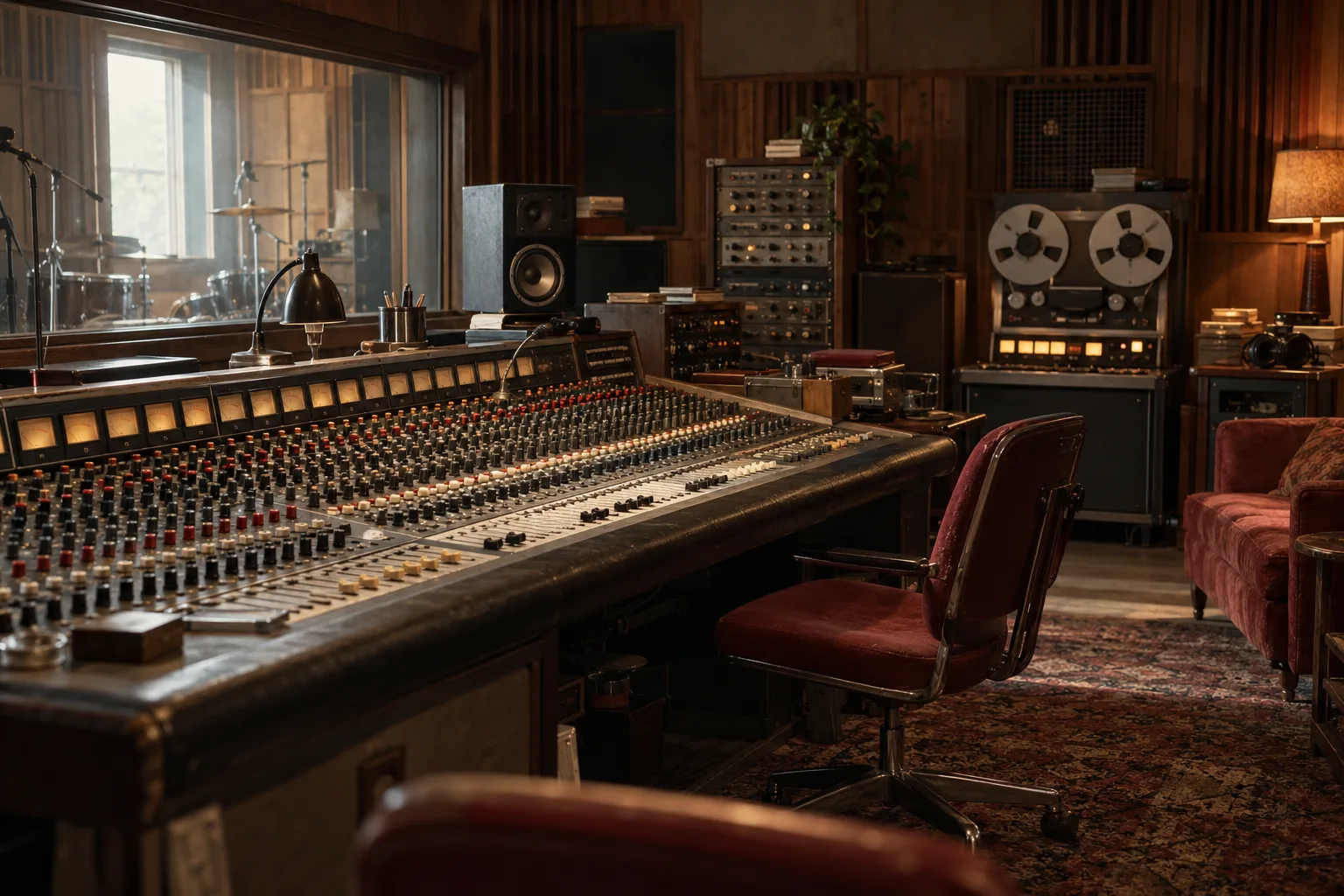
Keith Olsen was an American record producer, recording engineer and musician whose work connects several different chapters of rock music. Many listeners encounter his name through Fleetwood Mac's 1975 self-titled album. Others know the association with the Grateful Dead's Terrapin Station, Rick Springfield's songwriting, or later records by Whitesnake, Ozzy Osbourne and Scorpions. Those starting points lead into a working career rather than a single uniform sound.
His earlier life as a bass player belongs alongside the better-known production credits. Biographical sources place his musical development in Minneapolis and identify his membership in the Music Machine, the group associated with Talk Talk. Performance and studio work are related disciplines, but they are not identical. Playing a part means responding within the music; producing another artist's record can mean helping a whole project reach a coherent form.
The early engineering story also deserves attention. In his interview with Tape Op, Olsen discusses mixing home-recorded Emitt Rhodes material and addressing technical problems in the source tapes. That account makes the practical side of recording visible. The producer's later reputation does not erase the value of an earlier mixing contribution, and it does not make the original artist's authorship disappear.
This independent archive follows those changes in responsibility. It studies named recordings, keeps credit categories distinct and uses general recording context to help readers understand the work. It does not claim access to private session files or present speculation as an eyewitness account. For a chronological route, begin with the move from musician to producer.
A career timeline is a reading aid, not a complete session calendar. The album years below refer to original releases. Recording, mixing and release can occur at different times, and projects may overlap. The sequence helps locate the main periods without pretending that each one began and ended neatly.
Bass performance, the Music Machine and early studio experience form the opening chapter.
Mixing work and the 1973 Buckingham Nicks album establish identifiable studio projects.
Fleetwood Mac and Terrapin Station show two distinct production situations.
Collaborations extend across melodic rock, pop-oriented songs and heavier guitar music.
Surround-music advocacy and product-development work extend the story beyond album sessions.
The timeline is most useful when you choose one period and investigate a record within it. An early album can show a partnership taking shape; a later collaboration can show established musicians meeting a new recording context. The thread is continuity of work, not a claim that every project followed the same recipe.
A collaborator list can span very different audiences. Buckingham and Nicks began with a duo project; Fleetwood Mac brought an existing band history and several writers into a changed lineup. The Grateful Dead carried a live-performance culture in which songs could keep evolving. Rick Springfield's recollections highlight the importance of hearing a promising song among demos. Later hard-rock projects introduce still other voices, players and production teams.
The difference between those circumstances matters more than a long row of recognizable names. A producer adapts to the material and the people in the room. An established band is not a blank surface, and a vocalist's identity is not simply a product of processing. Reading the collaboration in context gives the artists their place while keeping the studio work visible.
Heart, Pat Benatar, Foreigner, Whitesnake, Ozzy Osbourne and Scorpions appear in institutional accounts of Olsen's catalog. That does not mean he produced every release by any of them. A reliable archive names the project and checks whether responsibility was shared. The artist-by-artist collaboration map offers a route through those associations without turning them into unsupported blanket credits.
Start with a small shelf rather than an exhaustive list. Buckingham Nicks supplies the earlier duo context; Fleetwood Mac captures the first studio album by the lineup with Buckingham and Nicks; Terrapin Station presents an outside producer working with a band whose live identity was already central to its audience. Later titles make the range of the catalog easier to hear.
| Record | Original year | Olsen connection | What to investigate |
|---|---|---|---|
| Buckingham Nicks | 1973 | Producer | The duo's identity before Fleetwood Mac |
| Fleetwood Mac | 1975 | Production and recording work | Several writers within one band album |
| Terrapin Station | 1977 | Producer and engineer | A fixed studio presentation of expansive material |
| Passionworks — Heart | 1983 | Producer | Vocal identity within a band arrangement |
| Slip of the Tongue — Whitesnake | 1989 | Production with Mike Clink | Shared responsibility and changing personnel |
| Crazy World — Scorpions | 1990 | Production with the band | Album pacing across harder songs and ballads |
Exact edition credits take priority over a summary table when you need track-level detail. A remastering credit belongs to the later presentation of a release; it does not automatically replace the original producer. A digital catalog's date may identify a reissue rather than the first album. The discography and credits article explains how to keep those distinctions readable.
Rhino's history of Buckingham Nicks places its recording at Sound City and identifies Olsen as producer. The later studio playback for Mick Fleetwood helped place the duo's work before a musician considering his band's next recording situation. The subsequent personnel decisions brought Buckingham and Nicks into Fleetwood Mac, whose 1975 self-titled album became the next important recording reference.
This sequence is meaningful without being expanded into a claim that Olsen created the band's entire later success. The existing members, the newcomers, the songwriting and the performances all matter. The 1975 record also needs to remain distinct from Rumours, which belongs to a different production team and a later project.
For listeners, compare the duo's earlier presentation with the changed band setting. Then listen to a Christine McVie song so the comparison keeps the established band visible. Our early Fleetwood Mac history follows the connection and its limits. It is a way into the music, not a substitute for the group's wider history.
Production style is often discussed as though one person carries an unchanging sound from record to record. Olsen's varied collaborations make that assumption difficult to support. A more useful approach asks what each recording emphasizes: a clear vocal narrative, instrumental exchange, a large chorus, a compact hook or the continuity of a longer arrangement.
Some technical work is documented. The Tape Op interview on Emitt Rhodes describes problems in the source recordings and the challenges of addressing them during mixing. That is a specific example of engineering judgment. It should not become a claim that Olsen used the same method on every later album.
Other observations belong to editorial listening. Describing a vocal as forward, an arrangement as spacious or a chorus as dense is a way to express what you hear. It is not proof of an equalizer setting or of who requested a change. Our classic-rock production guide keeps those categories separate so readers can discuss the records without invented quotations or session recipes.
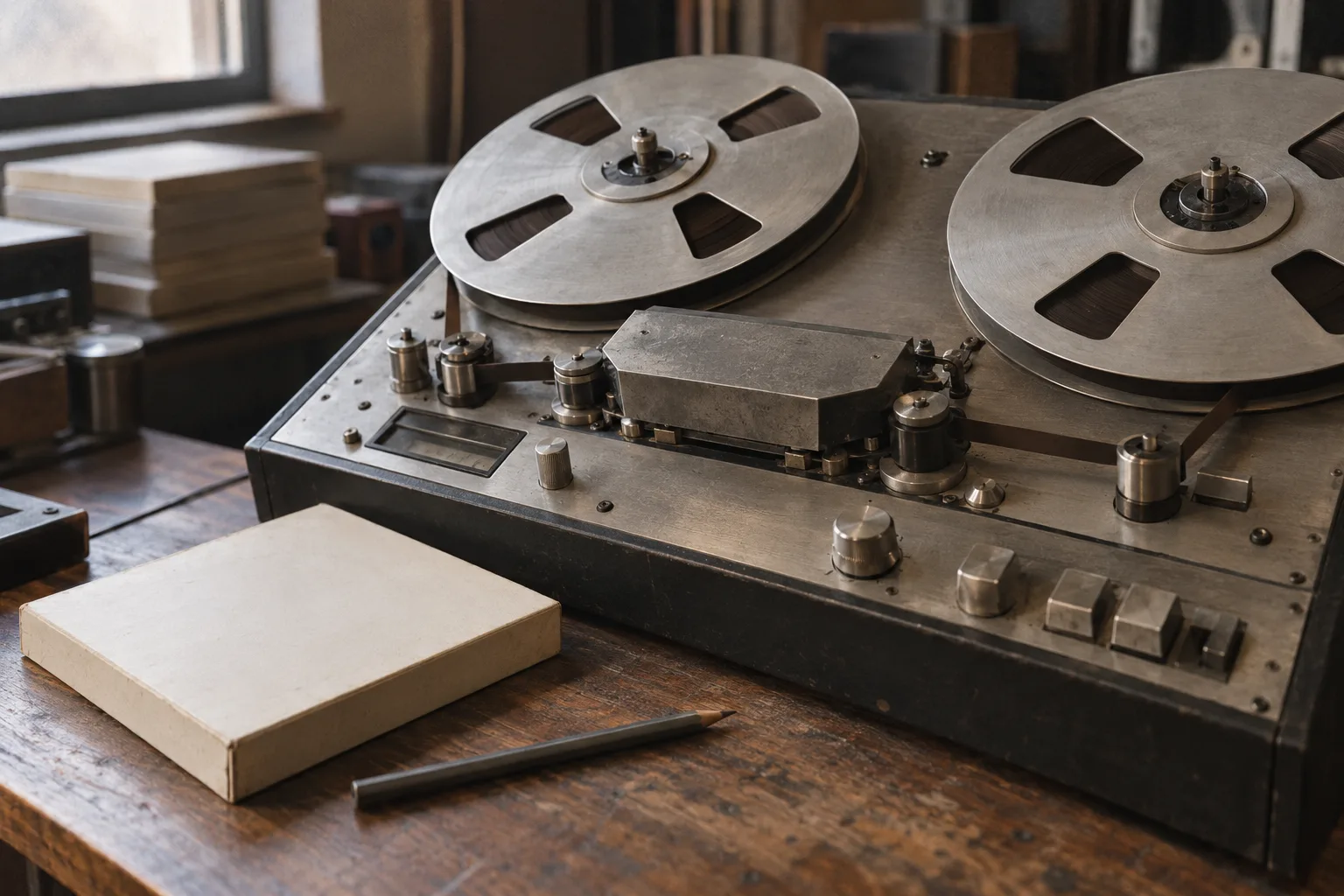
Analog recording, multitrack tape and mixing consoles form much of the historical setting around the best-known records. These tools create possibilities and limitations, but they do not explain every musical result. A restricted number of tracks may affect planning. Noise or distortion in a source recording may affect later mixing. The performance and arrangement still determine what the engineer has to work with.
A take, an overdub, a mix and a master are different stages. A take is one recorded performance attempt. An overdub adds material to an existing recording. Mixing combines recorded elements into a finished balance. Mastering prepares that balance for release. One person can perform several jobs, but the words should not be treated as interchangeable credits.
This site uses generated images of fictional studio environments to illustrate those concepts. They are not photographs of Olsen, Sound City or a historical album session. The recording-era article provides the technical background while identifying the direct accounts on which specific historical examples rely.
The catalog links recordings that different listeners may discover separately. Following a production credit can lead someone from a familiar song to a less familiar artist or from an album to the people who recorded it. That is a practical form of musical discovery, and it gives credit reading a role beyond collecting trivia.
Legacy also includes disagreement. Terrapin Station invites discussion about studio precision, orchestration and the relationship between an album and a band's live identity. A careful archive does not need to declare every choice universally admired. Different purposes and responses are part of recording history.
The Cinema Audio Society's memorial adds another dimension through Olsen's surround-music advocacy and work in product development at Mackie. These activities extend the story into listening formats and the tools of recording. The legacy article follows those threads while keeping album work, technology work and personal remembrance distinct.
Pick two tracks from different projects and use the same playback system. Keep their apparent loudness reasonably similar. Follow the vocal on the first pass, the rhythm section on the second and the relationship between verse and chorus on the third. Write down what changes rather than reaching immediately for better or worse.
Keep factual notes separate from impressions. Album title, edition and credited role are reference information. A phrase such as the guitar leaves room for the vocal is a listening observation. If you want to explain why that happened in the studio, look for an interview or an original credit rather than turning the observation into an unsourced story.
Songs can also carry dreamlike associations and private imagery for listeners. If that side of interpretation interests you, DreamCipher's dream interpretation resources provide a separate reading path. Such personal associations are not evidence of a songwriter's intention or of a producer's technical decisions; they belong to the listener's experience.
The archive begins with publicly available biographical references and cross-checks central album connections using label histories, artist pages, direct interviews and institutional remembrances. Sources are linked on each article. General recording explanations and editorial listening prompts are labeled by their context rather than dressed up as undocumented session facts.
The site name identifies this editorial project; it does not establish an affiliation with Keith Olsen, his family, the artists or the record labels. The writing was prepared with AI assistance and should receive an owner's editorial review before publication. The images are generated illustrations of environments, not authentic archival photographs. Our editorial policy explains these boundaries and how correction requests should be supported.
This is a selected resource, not a certified complete discography. Credits may become more precise when an original booklet or another direct source is available. Accuracy is served by preserving uncertainty where evidence is incomplete and by making a correction when better evidence resolves it.
Different questions. Different records. A connected listening path.
A listening map of selected recordings, with the distinctions that make production credits useful.
Prepared
Listen beyond the idea of a signature sound: songs, arrangements and the practical choices behind finished records.
PreparedThe route from Buckingham Nicks to the 1975 album, and why the boundaries of that connection matter.
PreparedA collaboration map organized around musical identities rather than a list of famous names.
PreparedTape, consoles, overdubs and mixes: a plain-language guide to the environment around the records.
PreparedA career built across performance, studio work and changing kinds of musical responsibility.
PreparedHow to remember production work through records, credits, technology and the listeners who return to them.
PreparedHe was an American record producer, audio engineer and musician whose catalog includes collaborations with Fleetwood Mac, the Grateful Dead and many other rock artists.
The key reference is the 1975 self-titled album, the first with Lindsey Buckingham and Stevie Nicks. Olsen also produced their 1973 duo album, Buckingham Nicks.
No. Rumours is a separate 1977 project associated with Fleetwood Mac, Ken Caillat and Richard Dashut. Do not extend the 1975 credit to that album.
Try Buckingham Nicks, Fleetwood Mac (1975), Terrapin Station and Crazy World. They offer different contexts rather than four versions of one production style.
Yes. Biographical accounts identify him as a bass player, including membership in the Music Machine before his best-known production work.
No. A producer can guide the musical project, while an engineer handles recording systems. Responsibilities can overlap, but the exact album credits should be checked.
No. This is an independent editorial resource. It does not represent Olsen, his family, the musicians or labels discussed here.
No. They are AI-generated illustrations of fictional recording environments, used to explain studio concepts rather than document real sessions.
These references support the named historical examples. Listening prompts and general studio explanations are editorial context, not claims of firsthand session access. Consult original release booklets for exact track and edition credits.